

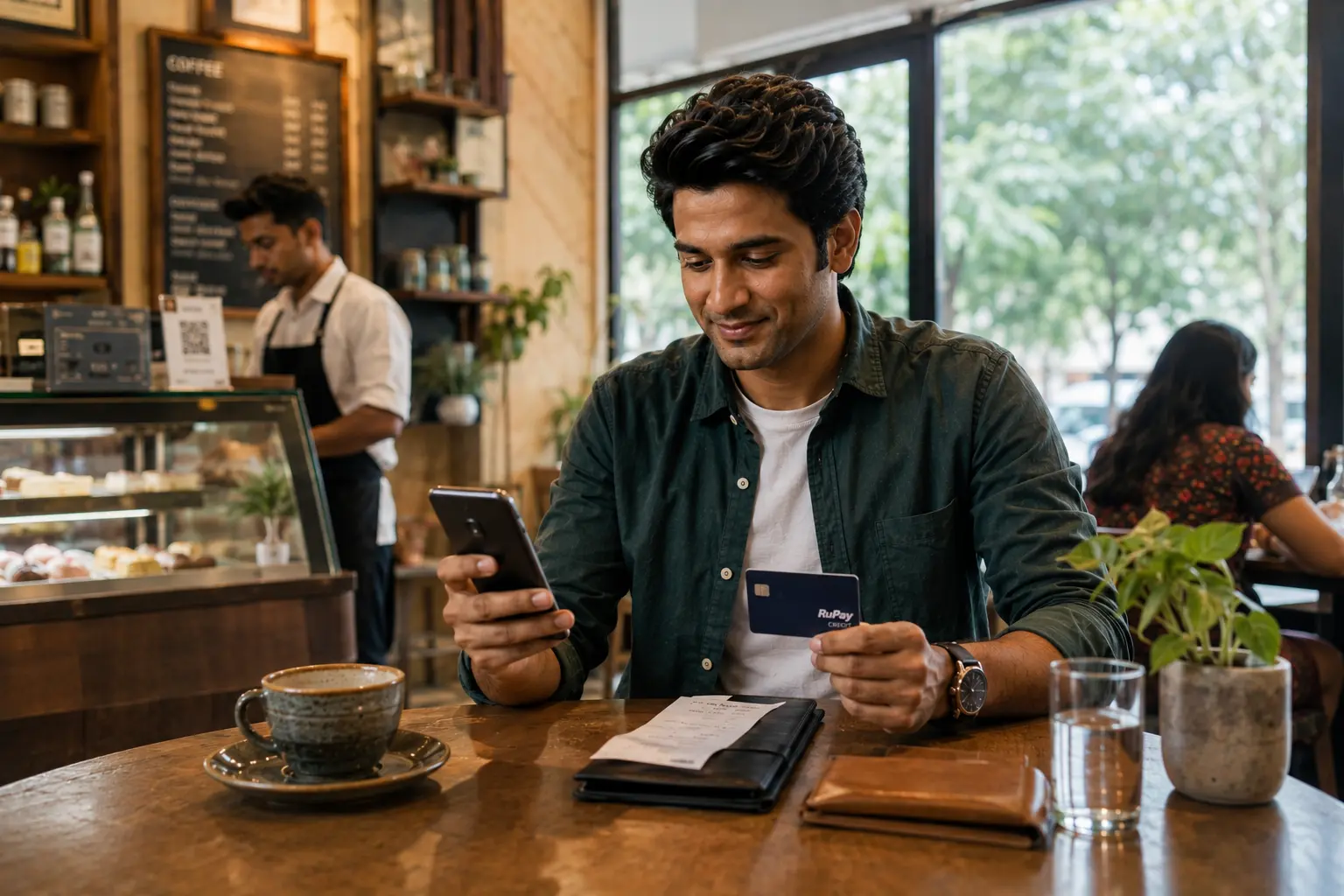

UPI has made digital payments feel effortless. Scan a QR code, enter your PIN, and you’re done.
Now that credit cards can be linked to UPI, a lot of people have the same question: is UPI with credit cards safe?
It is. When you pay through UPI using a credit card, you’re still using the same UPI system that millions of people rely on every day.
The process may seem simple because of its convenient design and structure, but there are multiple checks happening in the background before sending your money to anyone.
That said, safety isn’t just about the technology. It’s also about how you use it.
Most payment frauds don’t happen just because UPI suddenly stops being secure. They happen when someone scans a fake QR code, clicks a suspicious link, or shares information they shouldn’t.
So, the real question isn’t whether UPI with credit cards is safe. It’s how safe it is when used correctly.
How Does a UPI Credit Card Transaction Actually Work Behind the Scenes?
When you scan a QR code and pay, your phone does not send your real card number anywhere.
Instead, it sends a surrogate card number. This code is created only once, the first time you add your card to the UPI app. After that, every time you pay, this same code is used. Your real card number is never sent again.
Once you scan the code and enter the amount, your UPI app sends the payment request to your bank through NPCI rails (including TSP and PSP).
Your bank then checks everything back and forth including two simple things: is the card active and is there enough limit available to make this payment. After that, your UPI PIN is also checked.
If everything looks fine, your bank approves the payment right. The money is then sent to the receiver’s bank, and you see Payment Successful on your screen.
Common Safety Concerns
In the online payment world, worries about fraud and unauthorised access are obvious. Some of the usual concerns include:
- Phishing scams designed to steal PINs, OTPs, or card details
- Unauthorised transactions if a phone is lost or compromised
- Data theft during payment processing
- Fraudulent merchants or payment requests
- Fake QR codes that redirect payments to the wrong recipient
How to Avoid this
While you can overcome common risks by keeping your PIN, CVV, and other card details safe as well as using a screen lock on your phone, be mindful of the latest QR code scams.
These can range from phishing (called quishing in this context) and fake payment pages to malicious downloads, scams that redirect to phony IDs, and fraudulent QR stickers placed over genuine codes in public spaces.
To stay safe, avoid scanning codes from unknown messages or emails, and check public QR codes for signs of tampering before scanning them.
You should also avoid installing apps from unverified sources and regularly review the apps and permissions on your phone. If you notice an unfamiliar app with access to your screen, accessibility settings, or device controls, remove it immediately.
Also, never install screen-sharing or remote-access apps at someone’s request, even if they claim to be from your bank or a customer support team.
Verifying the merchant’s name displayed in the app before entering your PIN is a good practice.
Keep in mind that UPI transactions are protected via several security layers, but scams are caused by user behaviour. So, act cautiously.
What Security Layers Protect You During Every Credit Card UPI Payment?
The UPI credit card ecosystem uses multiple security checks to ensure that only you can authorise payments from your account.
Two-Factor Authentication (2FA) and PIN Security
Every credit card UPI payment is protected by two-factor authentication. The first layer is your device lock, while the second is your UPI PIN.
Even if someone gains access to your phone, they cannot complete a transaction without the PIN. This is one of the key UPI safety features that strengthens UPI credit card security.
Fraud Monitoring and Real-Time Alerts
Banks and the NPCI continuously monitor transactions for unusual activity.
If a payment appears suspicious, it may be flagged or blocked for further verification. You also receive instant transaction alerts through SMS and app notifications.
How Does Tokenization and Device Binding Keep Your Data Safe?
Your credit card details within any UPI app are guarded by several security layers that work in tandem to keep transactions secure. Here’s how:
How UPI Tokenisation Works
One of the most important UPI safety features is UPI tokenisation. Instead of utilising your actual 16-digit card number, the system swaps it out with a unique digital token.
So, when you make a credit card payment via UPI, this token is what gets used to facilitate the transaction. This, in turn, helps reduce the chances of your card details being exposed.
It’s one of the reasons more Indians are choosing to link their credit cards to UPI. Here’s a closer look at why this shift is happening.
How Device Binding Adds Another Layer of Security
Device binding ties your UPI account to a verified mobile device, along with a registered SIM.
This ensures your account cannot just be accessed from another phone without following the required verification steps.
By keeping access limited to allowed devices, device binding makes UPI credit card security stronger.
What Role Do the NPCI and the RBI Play in Securing Digital Transactions?
The safety of a credit card on UPI goes beyond technology. It is also backed by regulations and security standards designed to protect you throughout the payment process.
Regulatory Oversight and RBI Protections
The Reserve Bank of India requires banks to provide round-the-clock channels for reporting unauthorised transactions.
If a third-party breach occurs and you report it to your bank within 3 working days, you are protected from financial liability under RBI guidelines. These protections add an important layer of security to UPI credit card transactions.
NPCI Security and Technical Standards
NPCI sets and manages the technical standards that power UPI.
Through measures such as encryption, two-factor authentication, fraud monitoring, and regular security controls, it helps keep the UPI ecosystem secure.
How Does the UPI Dispute Redressal Mechanism Work for You?
No matter what your issue is, whether money was debited but not credited to the recipient or you notice an unauthorised transaction you can raise a complaint directly through your UPI app or by visiting the official NPCI Dispute Redressal Mechanism website called UPI Help.
Once you raise a dispute on the portal, you can track your complaint’s status using a Complaint Reference Number (CRN). Rest assured that your dispute will be resolved within 3-7 working days.
Raise a dispute on the UPI website https://www.upihelp.npci.org.in/ by following these steps:
1. Enter your phone number and complete the security verification
2. Select the type of transaction (person to person or person to merchant)
3. Enter your details along with the specific transaction ID
4. Choose the issue type (e.g., amount debited but not credited)
5. Submit the form to start the redressal procedure
To summarize, linking a credit card to UPI does not reduce its security. In fact, the transaction still goes through the same card network and banking security checks, along with UPI’s own safeguards.
On top of that, measures like tokenisation, SIM binding, and PIN verification make it harder for anyone to misuse your card or account.
Frequently Asked Questions
Can credit cards on UPI be hacked if I lose my phone?
It is highly unlikely. Thanks to device binding and the mandatory UPI PIN, an unauthorised user cannot access your credit card on UPI by possessing your phone.
While creating the pin make sure your UPI pin should be different from your phone pin and should not be shared with anyone.
How does RuPay UPI security compare to Visa or Mastercard?
RuPay UPI offers security standards similar to Visa and Mastercard.
Features such as encryption, tokenisation, and UPI PIN verification help keep transactions secure.
Once your RuPay credit card is linked to UPI, you can make scan and pay transactions with the same convenience without compromising on security.
What are some safety measures to follow when using a credit card?
Never share your PIN, OTP, CVV, or card details, even with someone claiming to represent your bank or other reputable institutions. Enable protection measures on your phone like screen lock, biometric lock, face ID, etc. to prevent easy access in case of theft.
Only use trusted UPI and payment apps for transactions and keep them updated to the latest version.
Avoid making payments over public Wi-Fi networks, especially when entering sensitive information.
Enable transaction alerts so you are notified instantly whenever your card is used.